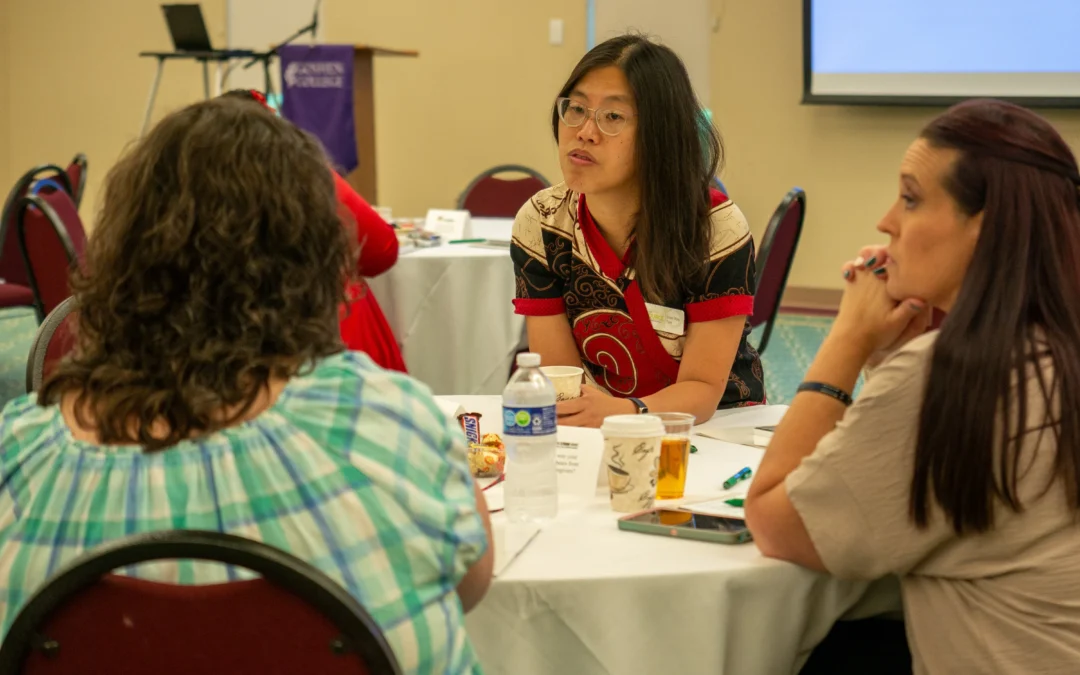
At the June 9 Building Strong Brains convening, Shin Yee Tan stood before about 80 coalition partners and asked a simple question: whose voices are actually in the room?
The answer was honest. Not all of them.
Shin YeeTan, manager at The SOURCE and a longtime contributor to the coalition’s family voice work, walked the group through years of intentional effort to hear from parents who don’t typically attend gatherings like this one. Parents who identify as immigrants. Amish families. Latine parents. Black parents. The conversations took place one-on-one, in homes and community spaces, with the goal of learning what school readiness looks like from families’ actual standpoints.
That work has been in the making for a while. In 2021, Building Strong Brains held parent listening sessions that shaped the coalition’s three action teams. Since then, focus groups about what was then called Kindergarten Boot Camp, now Countdown to Kindergarten, have generated enormous gratitude from families and at least one request that stuck: a parent who said she wished there were a place to get her child ready for school without having to worry about income. This summer’s Countdown to Kindergarten program is a direct response to that.
Community Resource Navigators, now celebrating their first year, took things a step further. Rather than simply surveying families, they documented what they saw through photography, capturing images of barriers, of hope, of what the pressure of systems looks like on a family’s daily life. Those photos and captions are now in the hands of coalition partners, as Shin Yee called them “a precious gift.”
At the convening, partners were given a sample of those family voice materials and asked to sit with them, discuss them at their tables, and name themes. The word cloud that emerged put hope and engagement at the center, followed by access and community, and then a harder set of words: barriers to care, isolation, fear of asking for help, and misunderstanding of needs.
One partner described what happens when agencies don’t communicate well enough: families go from door to door, hit dead ends, and sometimes receive conflicting information that leaves them feeling hopeless. Another said that what families need most is to feel like what they say actually matters, and that trust builds when people sense they are genuinely heard.
The group was then asked to name one concrete change they would like Building Strong Brains to make to better center the family voice. The ideas that came back were substantive. A family advisory council with real decision-making power. Parent representation on every action team and committee. Family forums are spread across the community so that families have places to speak in their own neighborhoods. One participant pushed back carefully on the risk of tokenism: having families on committees is not the same as letting their priorities drive the agenda.
Lindsay Aguilar acknowledged that family voice is not a new challenge, and that many partners at the table have been working on it for years. The coalition’s role, she said, is to ask what it would take to strengthen what already exists, to bring capacity and resources to those efforts, and to carry what families are saying back into action team decision-making.
That question of what families are carrying is not abstract. It’s in the photos the community resource navigators took, in the quotes collected from parent panels, in a small booklet on kindergarten readiness that went through family review before it was printed. It is being treated, as Shin Yee asked, as a gift.
The next step for Building Strong Brains on family voice is still taking shape. More to come.